
- Home
- »
- Sustainable Energy
- »
-
Solar Encapsulation Market Size & Share Report, 2026-2033GVR Report cover

Solar Encapsulation Market (2026 - 2033)
Size, Share & Trends Analysis Report By Material (Ethylene Vinyl Acetate (EVA), Thermoplastic Polyurethane (TPU)) By Technology (Crystalline Silicon Solar, Thin-Film Solar), By Application, By Region, And Segment Forecasts
Market Size, 2025
$10.0BMarket Estimate, 2026
$11.0BMarket Forecast, 2033
$17.0BCAGR, 2026–2033
6.4%Solar Encapsulation Market Summary
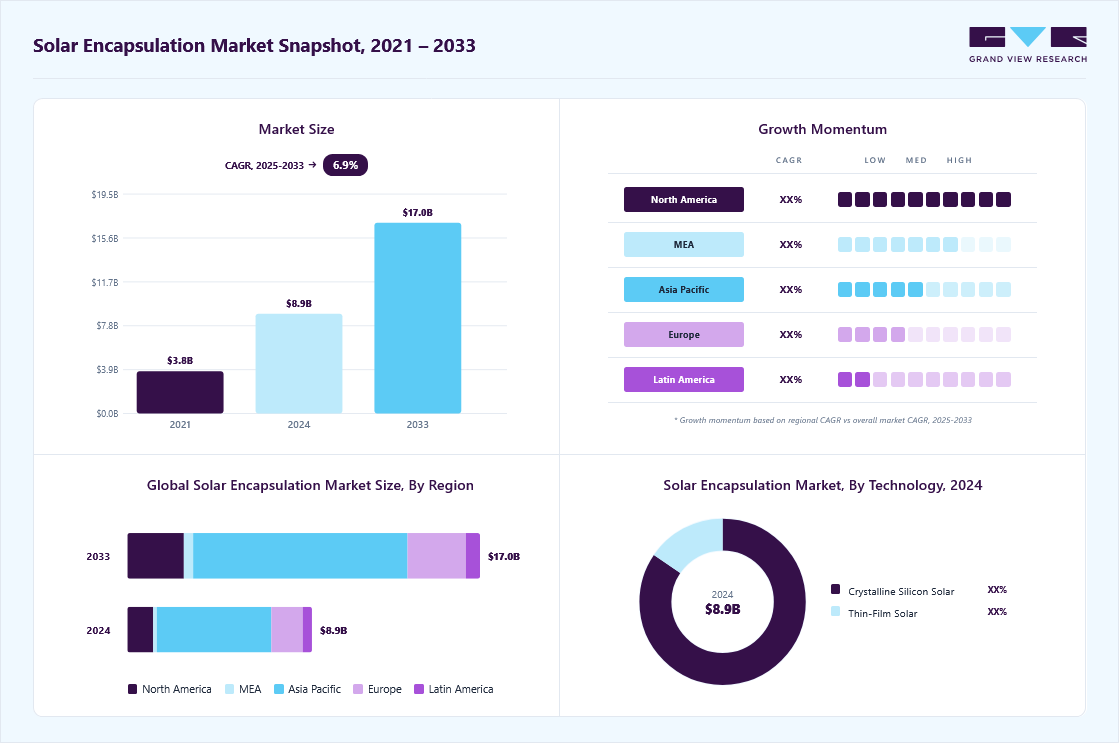
The global solar encapsulation market size was valued at USD 10.0 billion in 2025 and is projected to grow from USD 11.0 billion in 2026 to USD 17.0 billion by 2033, at a CAGR of 6.4% from 2026 to 2033. Asia Pacific dominated the solar encapsulation market with the largest revenue share of 61.9% in 2025. Solar encapsulation refers to the protective layer in photovoltaic (PV) modules that shields solar cells from environmental damage, such as moisture, UV rays, and mechanical stress. These encapsulants enhance durability, improve efficiency, and extend the operational life of solar panels.
 Source: Grand View Research, IR Documents, Primary Interviews, Paid DatabasesTo learn more about this report,
 Download Free Sample Report
 Key Market Trends & Insights
- By material: Ethylene vinyl acetate (EVA) segment held the largest market share of 63.4% in 2025.
- By technology: Crystalline silicon solar segment held the largest market share of 83.6% in 2025.
- By application: Ground-mounted segment held the largest market share of 70.0% in 2025.
Regional Highlights
- Largest regional market: Asia Pacific (61.9% revenue share, 2025)
- Fastest-growing regional market: Middle East & Africa (highest CAGR, 2026-2033)
- By country: China held the largest market share in 2025
Market Size & Forecast
- Market size in 2025: USD 10.0 Billion
- Estimated market size in 2026: USD 11.0 Billion
- Projected market size by 2033: USD 17.0 Billion
- CAGR (2026-2033): 6.4%
Three ways to get this report
Buy it, customize it, or ask a question.Ask an Analyst
Analyst response in 1 business day
- AccessReport author, directly
- Reply timeWithin 1 working day
- No sales callDirect answer only
- FormatEmail reply
- CostFree, no cost
Get the Full Report
What the study covers
- FormatsPDF · Excel · Dashboard
- Timeline2026–2033 annual, 2025 base
- Coverage20+ countries, 5 regions
- Companies10+ key players profiled
Customize the Report
20% free customization
- IncludeCountries, segments, points
- TailorTo your product definition
- ExtendDeeper competitor detail
- OrA fully bespoke study
- Turnaround5–10 working days
The growing demand for renewable energy and continuous advancements in solar module designs are driving the market forward. In addition, increasing investments in large-scale solar energy projects and favorable government initiatives to reduce greenhouse gas emissions are expected to fuel market growth further.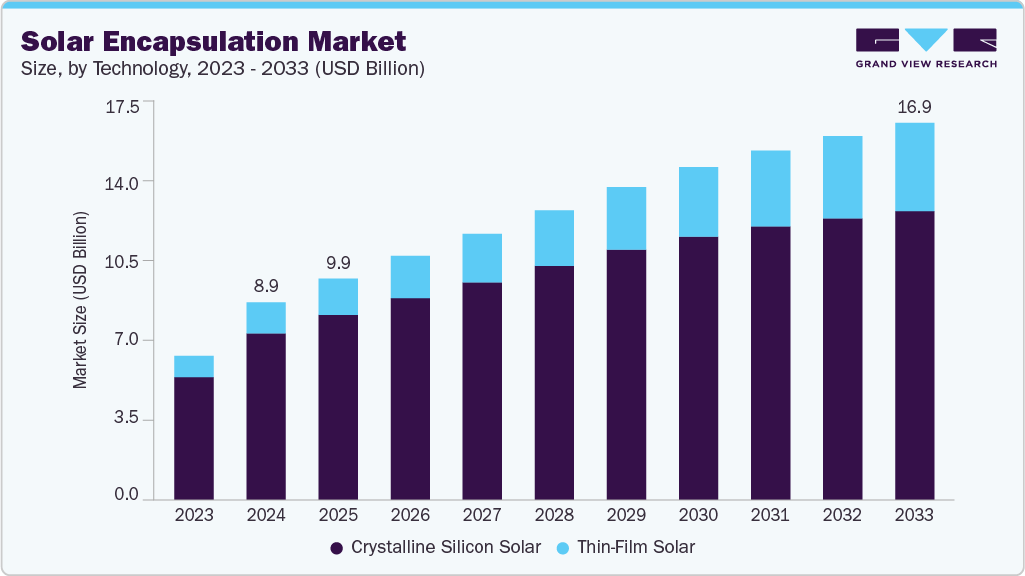 To learn more about this report, Download Free Sample Report
 Encapsulants are critical to the structural integrity and performance of crystalline silicon and thin-film solar technologies. Materials such as Ethylene Vinyl Acetate (EVA), Polyolefin, and Thermoplastic Polyurethane (TPU) dominate the landscape due to their cost-effectiveness and excellent optical and adhesive properties. The rising adoption of bifacial and high-efficiency PV modules is creating demand for next-generation encapsulation materials with better UV stability and lower degradation rates. Major solar-producing countries such as China, India, the U.S., and Germany are significantly contributing to market expansion through ambitious solar deployment targets and local manufacturing incentives. The market outlook remains strong as the global energy mix shifts toward clean and sustainable solutions.
Market Dynamics
The solar encapsulation market is driven by rising solar PV installations across ground-mounted, building-integrated, floating, and emerging applications, supported by increasing adoption of crystalline silicon and thin-film technologies. Demand is shifting toward advanced encapsulation materials such as polyolefin, ionomer, TPU, and PDMS, alongside conventional EVA, to improve module durability and performance. Growth is further supported by the need for enhanced moisture resistance, thermal stability, and longer module lifecycles. However, raw material price fluctuations and cost pressures remain key challenges for market participants.
The growing installation of solar PV systems is a major driver for the solar encapsulation market. As more utility-scale, commercial, residential, and floating solar projects are developed, the demand for encapsulation materials increases to protect solar cells and improve module durability. The rising adoption of high-efficiency solar technologies, including bifacial and advanced crystalline silicon modules, is also increasing the need for reliable encapsulation solutions that can withstand harsh environmental conditions and extend module lifespan.
In January 2026, LONGi Green Energy Technology announced the expansion of its high-efficiency solar module production capacity to support growing global demand for advanced PV modules. The increasing production of next-generation modules, including bifacial and high-performance crystalline silicon products, is expected to drive demand for advanced encapsulation materials that provide improved reliability, moisture resistance, and long-term module protection.
The solar encapsulation market faces challenges due to fluctuations in raw material prices and increasing pressure to reduce module manufacturing costs. Materials such as EVA, POE, TPU, and other polymer-based encapsulants are affected by changes in petrochemical feedstock prices, supply chain disruptions, and manufacturing costs. Solar module manufacturers are continuously seeking cost optimization, which can limit the adoption of higher-cost advanced encapsulation materials despite their performance benefits. Companies including JA Solar Technology Co., Ltd. and other leading PV manufacturers are focusing on improving production efficiency and lowering component costs to maintain competitiveness.
The increasing adoption of high-efficiency solar modules and next-generation PV technologies is creating new opportunities for advanced encapsulation materials. Technologies such as bifacial modules, TOPCon, and heterojunction (HJT) cells require encapsulants with better moisture resistance, thermal stability, and protection against degradation. This is driving demand for materials such as POE, ionomer, and other advanced polymer solutions, especially in utility-scale, floating PV, and building-integrated photovoltaic applications where long-term reliability is critical. In 2025, Trina Solar Co., Ltd. expanded the deployment of its high-efficiency Vertex solar modules, including advanced bifacial and n-type technologies designed for improved energy output and durability.
Analyst Perspective
The solar encapsulation market is experiencing rapid growth, supported by rising solar PV installations and increasing demand for durable, high-efficiency modules. Established chemical companies continue to lead through advanced material development, while emerging Asian manufacturers are gaining market share through cost-effective production and regional supply advantages. The shift toward bifacial modules, TOPCon, and heterojunction technologies is increasing demand for advanced encapsulants such as POE and multi-layer films with improved reliability. A key trend in the market is the growing adoption of sustainable and recyclable encapsulation materials to improve module lifecycle performance and reduce environmental impact.
Material Insights
Based on material, the ethylene vinyl acetate (EVA) segment led the market with the largest revenue share of 63.4% in 2025. The Ethylene Vinyl Acetate (EVA) segment emerged as the dominant material in the market, accounting for more than 65.45% revenue share in 2024. It is further projected to maintain its lead throughout the assessment period. EVA's widespread adoption is driven by its excellent optical transmission, strong adhesion to solar cells, and cost-effectiveness, making it the preferred choice for encapsulating crystalline silicon modules globally. The rapid expansion of solar PV installations, fueled by increasing electricity demand from population growth and accelerated urban development, continues to support segment growth. In addition, the global transition from conventional fossil fuel-based energy to solar power, particularly in economies such as China, India, the U.S., and Germany, further boosts demand for EVA-based encapsulation materials, especially in large-scale solar farms exceeding 200 MW.
The increasing module size and higher power ratings in utility-scale solar projects have underscored the importance of materials like EVA, which offer proven long-term durability and performance under varying climatic conditions. Its ease of lamination and compatibility with both front and rear surfaces of solar cells make it ideal for streamlined mass production. Furthermore, EVA sheets' lightweight nature and flexibility contribute to improved module handling and structural design, which is critical for emerging applications such as floating solar, building-integrated photovoltaics (BIPV), and desert-based installations. As the renewable energy landscape evolves, EVA is expected to retain a strong foothold, while newer alternatives like Polyolefin Elastomers (POE) and Thermoplastic Polyurethane (TPU) gain momentum in niche, high-efficiency segments requiring enhanced thermal and UV resistance.
Technology Insights
Based on technology, the crystalline silicon solar segment led the market with the largest revenue share of 83.6% in 2025. The crystalline silicon solar segment accounted for the largest revenue share of approximately 84.40% in 2024. The global rise in electricity demand due to rapid urbanization, industrial expansion, and population growth has significantly boosted the adoption of crystalline silicon solar technology, driving the use of encapsulation materials tailored for this segment. Crystalline silicon modules, including monocrystalline and multicrystalline types, are favored for their high energy efficiency, long operational life, and well-established manufacturing base. The segment’s dominance is expected to continue over the forecast period, supported by falling module costs, consistent technology improvements, and supportive policy frameworks promoting solar adoption at utility and commercial scales.
While crystalline silicon remains the backbone of the solar market, newer technologies such as thin-film and tandem cells are gradually gaining attention. However, skepticism remains among some major players regarding the scalability and durability of alternatives compared to traditional crystalline silicon. Material demand in this segment is also subject to supply chain fluctuations and pricing volatility in encapsulant components like EVA and POE. On the other hand, the thin-film segment is experiencing niche demand in applications like building-integrated photovoltaics (BIPV), flexible modules, and off-grid solutions. Nonetheless, the robust infrastructure supporting crystalline silicon module manufacturing and its proven field performance are expected to uphold its dominant share across established and emerging solar markets worldwide.
Application Insights
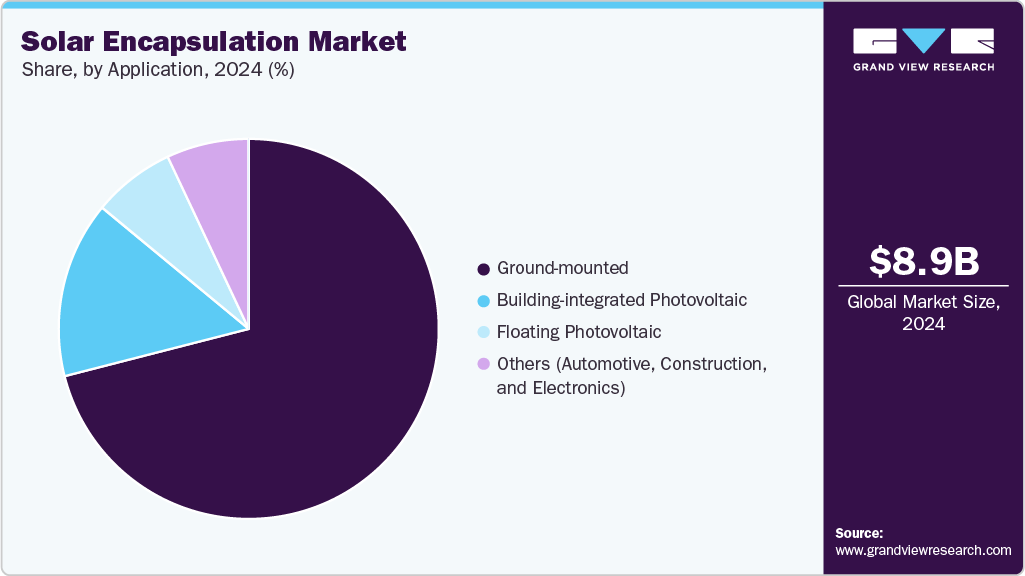
Based on application, the ground-mounted segment led the market with the largest revenue share of 70.0% in 2025. The ground-mounted segment accounted for the largest revenue share of more than 70.83% in 2024 and is anticipated to maintain its dominance throughout the forecast period. This segment is also expected to grow faster over the coming years. Ground-mounted solar systems offer higher energy yields due to optimal tilt and orientation and are generally more scalable than rooftop alternatives. These systems are ideal for utility-scale solar farms, allowing for economies of scale in installation and maintenance. As global solar deployment accelerates, especially in countries with abundant land availability, the demand for durable and efficient encapsulation materials for ground-mounted projects is driving overall market growth.
 To learn more about this report, Download Free Sample Report
 Ground-mounted installations complement large-scale power generation strategies by delivering consistent energy output and enabling easier integration with grid infrastructure. Their modular design allows quick scaling to meet rising energy demands, especially in remote or under-electrified areas. Government mandates promoting renewable energy targets and utility procurement programs favor the rapid rollout of such systems. In addition, declining costs of solar modules and improved installation technologies are enhancing the viability of ground-based solar projects. The increasing adoption of bifacial modules in this segment, which require advanced encapsulants with dual-sided durability and UV stability, is also expected to create new growth opportunities for encapsulation material manufacturers over the projection period.
Regional Insights
North America's solar encapsulation industry is driven by expanding renewable energy integration and federal clean energy initiatives. The region is experiencing large-scale PV deployment in utility and distributed generation segments, prompting demand for encapsulants that offer durability, optical clarity, and long-term reliability. Declining solar installation costs, improved net metering policies, and investor interest in green infrastructure have catalyzed market expansion. In addition, the growth of bifacial modules and tracker-based systems, especially in U.S. solar farms, requires encapsulant materials that can withstand mechanical stress and UV degradation, accelerating the adoption of advanced solutions like polyolefin and thermoplastic polyurethane.
U.S. Solar Encapsulation Market Trends
The U.S. solar encapsulation industry is bolstered by a robust pipeline of solar projects backed by the Inflation Reduction Act (IRA) and state-level renewable portfolio standards (RPS). Ground-mounted solar PV installations across California, Texas, and Florida fuel the demand for durable encapsulation solutions tailored for high-output utility-scale modules. The resurgence of domestic solar manufacturing and the push for supply chain localization have also spurred investments in local encapsulant production. Moreover, the shift toward high-efficiency technologies, including heterojunction and bifacial cells, creates demand for next-generation encapsulants offering enhanced thermal and moisture resistance
Asia Pacific Solar Encapsulation Market Trends
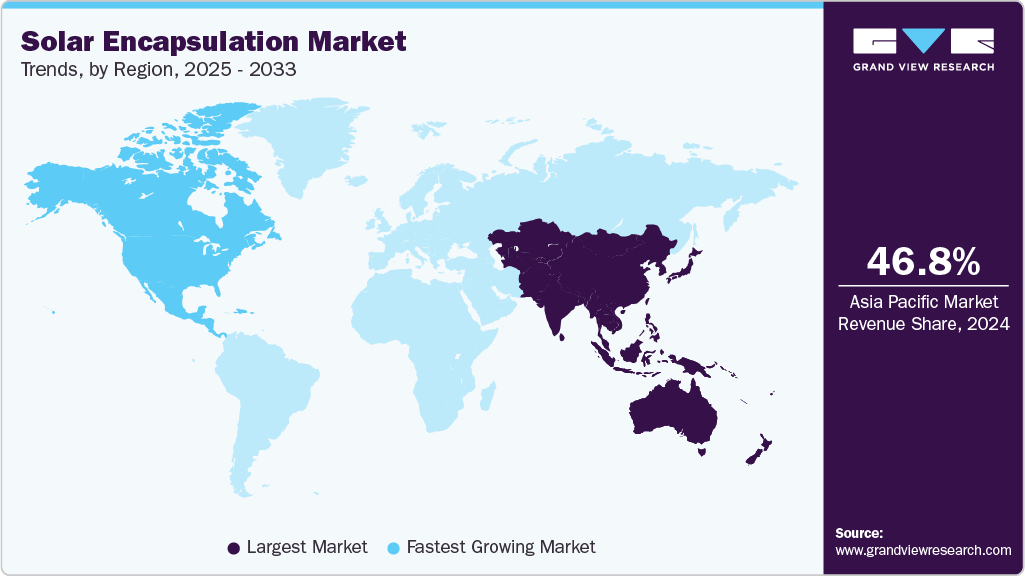
Asia Pacific dominated the solar encapsulation market with the largest revenue share of 61.9% in 2025. Massive solar capacity additions in countries like China, India, and South Korea are primary growth drivers. These nations are aggressively shifting away from fossil fuels, supported by strong national solar policies, land availability, and competitive module manufacturing ecosystems. The rising deployment of utility-scale solar parks and government-led renewable energy missions continues to boost demand for high-performance encapsulation materials. Furthermore, APAC's position as a manufacturing hub for solar PV modules ensures strong domestic demand, with key regional players investing heavily in advanced encapsulant production capabilities and R&D.
 To learn more about this report, Download Free Sample Report
 China Solar Encapsulation Market Trends
The solar encapsulation market in China held the largest share in the Asia Pacific region in 2025.
Europe Solar Encapsulation Market Trends
The European solar encapsulation industry is propelled by the region's aggressive climate targets and increasing solar PV adoption under the EU's REPowerEU and Green Deal strategies. Countries like Germany, Spain, and the Netherlands lead utility-scale and rooftop solar deployment, driving consistent demand for encapsulation films that offer optical and mechanical stability. Europe's high module performance and recyclability standards are pushing manufacturers to innovate with environmentally friendly and durable encapsulant materials. In addition, increasing R&D activity and government incentives for domestic module manufacturing support the adoption of advanced encapsulation technologies across the region.
Latin America Solar Encapsulation Market Trends
Latin America's solar encapsulation industry is growing steadily due to rising investments in renewable energy infrastructure across Brazil, Chile, and Mexico. The region's abundant solar irradiance and increasing demand for decentralized energy solutions make it an attractive landscape for utility-scale solar deployment. Government-backed energy auctions and feed-in tariff programs encourage the expansion of solar parks, where EVA and POE encapsulants enhance panel durability. Moreover, integrating solar energy into industrial and off-grid rural applications further diversifies encapsulation demand, especially for products that can withstand high temperatures and humidity.
Middle East & Africa Solar Encapsulation Market Trends
The Middle East & Africa solar encapsulation industry is witnessing growth driven by ambitious solar initiatives in Saudi Arabia, the UAE, Egypt, and South Africa. National Vision programs and renewable energy targets are accelerating utility-scale solar PV deployment, boosting the consumption of encapsulants designed for desert environments with high UV exposure and temperature fluctuations. The emergence of floating solar plants and hybrid solar-diesel solutions in off-grid areas also presents new opportunities for weather-resistant encapsulant materials. As solar module manufacturing capabilities expand within the region, demand for localized, high-performance encapsulation solutions is expected to rise.
Key Solar Encapsulation Company Insights
Some of the key players operating in the solar encapsulation industry include First Solar, DuPont, 3M, Dow, Mitsui Chemicals, Inc., among others. These companies are actively investing in research and development to innovate high-performance encapsulant materials such as EVA, POE, and TPU to meet evolving module efficiency and durability requirements.
Key Solar Encapsulation Companies:
The following key companies have been profiled for this study on the solar encapsulation market.
- First Solar
- DuPont
- 3M
- Dow
- Mitsui Chemicals, Inc.
- HANGZHOU FIRST APPLIED MATERIAL CO., LTD.
- LG Chem
- JA SOLAR Technology Co., Ltd.
- Shin-Etsu Chemical Co., Ltd.
- RenewSys India Pvt. Ltd.
Competitive Benchmarking
Category
Operating Strategies
Competitive Edge
Weakness
Established Players (DuPont, 3M, Dow, Mitsui Chemicals India Pvt. Ltd., LG Chem, Shin-Etsu Chemical Co., Ltd.)
- Focus on continuous innovation in advanced encapsulant materials, including high-performance EVA, POE, and specialty polymer solutions for next-generation PV modules.
- Leverage global manufacturing networks, extensive R&D capabilities, and long-term partnerships with leading solar module manufacturers.
- Diversify product portfolios across solar, electronics, automotive, and industrial applications to reduce dependency on photovoltaic demand cycles.
- Strong brand recognition and credibility among global PV manufacturers due to decades of materials expertise.
- Advanced R&D capabilities enabling development of high-performance encapsulants with improved durability, reliability, and weather resistance.
- Broad geographic presence and established supply chains supporting large-scale customer requirements.
- Higher production costs compared with regional PV material manufacturers, impacting price competitiveness.
- Slower market adaptation in highly price-sensitive solar supply chains dominated by Asian suppliers.
- Greater exposure to mature product segments where competition from low-cost manufacturers is increasing.
Emerging Players (RenewSys India Pvt. Ltd., Hangzhou First Applied Material Co., Ltd., Jiangsu Sveck Photovoltaic New Material Co.,Ltd., Vishakha Renewables Pvt. Ltd. )
- Expand domestic and regional manufacturing capacities to capture growing solar PV demand and reduce supply chain dependencies.
- Compete through cost-efficient production, localized supply chains, and faster customer support for module manufacturers.
- Focus on scaling EVA, POE, and advanced encapsulant film production to meet increasing demand from high-efficiency PV technologies.
- Cost advantages driven by localized manufacturing and lower operating expenses, particularly in Asian markets.
- Greater flexibility and faster response to customer requirements through regional production facilities.
- Strong alignment with government initiatives promoting domestic solar manufacturing and supply chain localization.
- Limited global brand recognition and lower customer trust compared with established chemical companies.
- Smaller R&D capabilities may restrict development of highly specialized or next-generation encapsulant technologies.
- Greater dependence on regional solar market growth and module manufacturing cycles.
Recent Developments
- In February 2025, Shin-Etsu Chemical Co., Ltd. announced the expansion of its solar encapsulation manufacturing operations in Houston, Texas. The new facility aims to enhance the production of advanced, high-performance encapsulant materials designed for next-generation photovoltaic modules, including bifacial and high-efficiency solar cells. This strategic move supports the rising demand for durable, UV-resistant, and thermally stable encapsulations as utility-scale solar projects gain momentum across the U.S. The expansion is also expected to generate approximately 400 skilled jobs and reinforce the domestic solar supply chain, aligning with federal efforts to boost clean energy manufacturing and reduce dependence on imports.
Solar Encapsulation Market Report Scope
Report Attribute
Details
Market Definition
The solar encapsulation market revenue is quantified through the sales of encapsulation materials, including EVA, TPU, PVB, PDMS, ionomer, and polyolefin, used in crystalline silicon and thin-film solar technologies across ground-mounted, building-integrated, floating photovoltaic, and emerging applications.
Market size in 2025
USD 10.0 billion
Estimated market size in 2026
USD 11.0 billion
Projected market size by 2033
USD 17.0 billion
Growth rate
CAGR of 6.4% from 2026 to 2033
Base year for estimation
2025
Historical data
2021 - 2024
Forecast period
2026 - 2033
Quantitative units
Revenue in USD Million and CAGR from 2026 to 2033
Report coverage
Revenue forecast, company ranking, competitive landscape, growth factors, and trends
Segments covered
Material, Technology, Application, Region
Regional scope
North America, Europe, Asia Pacific, Latin America, Middle East & Africa
Country scope
U.S., Canada, Mexico, Germany, UK, France, Russia, Italy, Spain, Norway, China, India, Japan, South Korea, Brazil, Argentina, Saudi Arabia, UAE, South Africa
Key companies profiled
DuPont, 3M, Dow, Mitsui Chemicals India Pvt. Ltd., LG Chem, Shin-Etsu Chemical Co., Ltd., RenewSys India Pvt. Ltd., Hangzhou First Applied Material Co., Ltd., Jiangsu Sveck Photovoltaic New Material Co.,Ltd., Vishakha Renewables Pvt. Ltd.
Customization scope
Free report customization (equivalent up to 8 analysts' working days) with purchase. Addition or alteration to country, regional & segment scope.
Pricing and purchase options
Avail customized purchase options to meet your exact research needs. Explore purchase options
Global Solar Encapsulation Market Report Segmentation
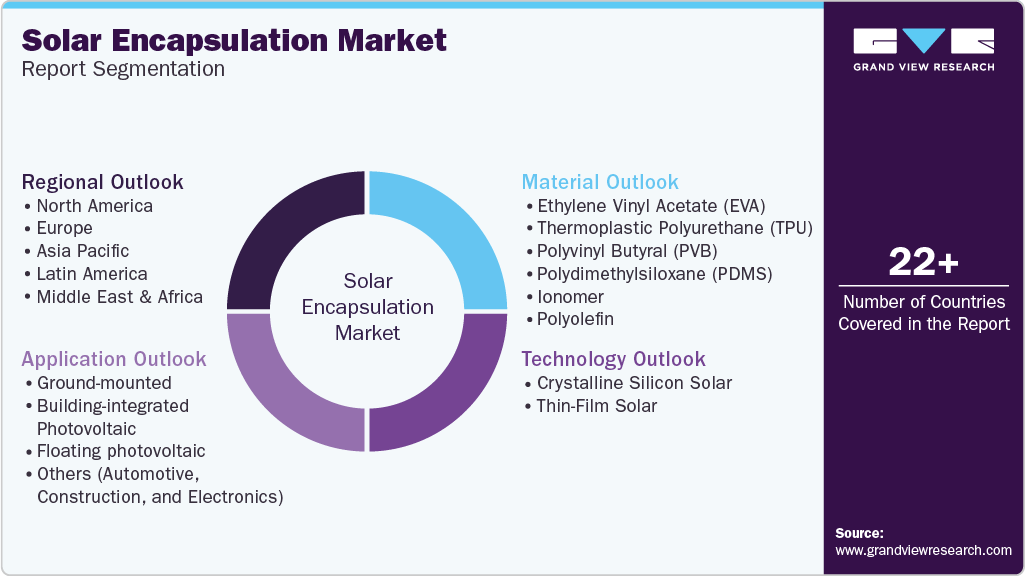
This report forecasts revenue growth at global, regional, and country levels and provides an analysis of the latest industry trends in each of the sub-segments from 2021 to 2033. For this study, Grand View Research has segmented the global solar encapsulation market report based on material, technology, application, and region.
 To learn more about this report, Download Free Sample Report
 -
Material Outlook (Revenue, USD Million, 2021 - 2033)
-
Ethylene Vinyl Acetate (EVA)
-
Thermoplastic Polyurethane (TPU)
-
Polyvinyl Butyral (PVB)
-
Polydimethylsiloxane (PDMS)
-
Ionomer
-
Polyolefin
-
-
Technology Outlook (Revenue, USD Million, 2021 - 2033)
-
Crystalline Silicon Solar
-
Thin-Film Solar
-
-
Application Outlook (Revenue, USD Million, 2021 - 2033)
-
Ground-mounted
-
Building-integrated photovoltaic
-
Floating photovoltaic
-
Others (Automotive, Construction, and Electronics)
-
-
Regional Outlook (Revenue, USD Million, 2021 - 2033)
-
North America
-
U.S.
-
Canada
-
Mexico
-
-
Europe
-
Germany
-
UK
-
France
-
Russia
-
Italy
-
Spain
-
Norway
-
-
Asia Pacific
-
China
-
India
-
Japan
-
South Korea
-
-
Latin America
-
Brazil
-
Argentina
-
-
Middle East & Africa
-
Saudi Arabia
-
UAE
-
South Africa
-
-
Research Methodology
The solar encapsulation insecticides market figures in this report are based on a proven research process that combines executive interviews with secondary research from proprietary databases, company filings, and recognized regulatory and institutional sources. Market size is built through value-chain sizing - reconciling supply-side and demand-side estimates - and triangulated with bottom-up and top-down approaches. Every estimate passes multiple levels of expert validation before publication, with each solar encapsulation insecticides segment quantified using the revenue-capture definitions in the table below.
Segment Definition
Segment - Material
Revenue capture definition
Ethylene Vinyl Acetate (EVA)
EVA solar encapsulants include ethylene vinyl acetate-based films widely used to protect photovoltaic cells from moisture, UV exposure, and mechanical stress. Revenue is generated from the sales of EVA encapsulation films used in crystalline silicon and thin-film solar modules across utility-scale, commercial, residential, and other solar applications.
Thermoplastic Polyurethane (TPU)
TPU solar encapsulants include thermoplastic polyurethane-based materials designed for enhanced flexibility, durability, and resistance to environmental conditions. Revenue is generated from the sales of TPU encapsulation materials used in specialized photovoltaic modules and emerging solar applications requiring improved mechanical performance.
Polyvinyl Butyral (PVB)
PVB solar encapsulants include polyvinyl butyral-based films used for their strong adhesion, optical clarity, and impact resistance properties. Revenue is generated from the sales of PVB encapsulation materials used in photovoltaic modules, particularly building-integrated photovoltaic (BIPV) and specialty solar applications.
Polydimethylsiloxane (PDMS)
PDMS solar encapsulants include silicone-based encapsulation materials offering high thermal stability, UV resistance, and long-term durability. Revenue is generated from the sales of PDMS encapsulation solutions used in high-performance photovoltaic modules and specialized solar applications operating under demanding environmental conditions.
Ionomer
Ionomer solar encapsulants include advanced polymer-based encapsulation films designed for high durability, moisture resistance, and improved module reliability. Revenue is generated from the sales of ionomer encapsulation materials used in high-efficiency solar modules, including bifacial, glass-glass, and next-generation photovoltaic systems.
Polyolefin
Polyolefin solar encapsulants include polyolefin-based films, including POE materials, used for improved moisture resistance and reduced degradation in solar modules. Revenue is generated from the sales of polyolefin encapsulation films used in advanced crystalline silicon modules, bifacial modules, and long-life photovoltaic installations.
Segment - Technology
Revenue capture definition
Crystalline Silicon Solar
Crystalline silicon solar encapsulation includes encapsulant materials used for protecting mono-crystalline and polycrystalline silicon photovoltaic cells. Revenue is generated from the sales of encapsulation films deployed in crystalline silicon solar modules across ground-mounted, rooftop, floating, and commercial solar installations.
Thin-Film Solar
Thin-film solar encapsulation includes encapsulant materials used for lightweight and flexible photovoltaic technologies based on thin-film semiconductor materials. Revenue is generated from the sales of encapsulation solutions used in thin-film solar modules across specialized applications such as BIPV, portable solar systems, and other emerging photovoltaic installations.
Segment - Application
Revenue capture definition
Ground-mounted
Ground-mounted solar encapsulation includes encapsulation materials used in utility-scale and large solar installations deployed on open land areas. Revenue is generated from the sales of encapsulation films integrated into photovoltaic modules installed across large-scale solar farms.
Building-integrated photovoltaic
BIPV solar encapsulation includes encapsulation materials used in photovoltaic systems integrated into building structures such as facades, roofs, and windows. Revenue is generated from the sales of specialized encapsulation solutions used in aesthetically integrated and durable solar modules for building applications.
Floating photovoltaic
Floating photovoltaic solar encapsulation includes encapsulation materials designed for solar modules installed on water bodies such as reservoirs and artificial lakes. Revenue is generated from the sales of encapsulation films used in floating PV modules requiring enhanced moisture resistance and environmental durability.
Others
Other solar encapsulation applications include encapsulation materials used in emerging photovoltaic applications such as solar-powered vehicles, construction-integrated systems, and electronic devices. Revenue is generated from the sales of specialized encapsulation solutions used in niche and innovative solar applications.
Estimation Model
Layer Name
Key Question
Description
Solar Encapsulation Material Demand Layer
What drives the demand for solar encapsulation materials?
Identify key demand drivers for solar encapsulation materials, including increasing solar PV installations, rising adoption of high-efficiency modules, demand for longer module lifespans, growth of bifacial and glass-glass solar modules, and increasing focus on module reliability under harsh environmental conditions. Assess factors such as renewable energy targets, solar manufacturing expansion, and technology advancements influencing encapsulant demand.
Solar Encapsulation Material & Technology Layer
What materials and solar technologies use encapsulation solutions?
Analyze adoption of solar encapsulation materials based on material types (EVA, TPU, PVB, PDMS, ionomer, and polyolefin) and solar technologies (crystalline silicon and thin-film solar). Assess material preferences based on moisture resistance, thermal stability, durability, cost competitiveness, compatibility with advanced PV technologies, and performance requirements.
Solar Encapsulation Application Layer
Where are solar encapsulation materials deployed?
Evaluate solar encapsulation demand across ground-mounted, building-integrated photovoltaic (BIPV), floating photovoltaic, and other applications including automotive, construction, and electronics. Assess demand based on installation scale, environmental exposure, module reliability requirements, and adoption of specialized photovoltaic solutions.
Revenue Layer
How is market revenue generated?
Market revenue is quantified through the sales of solar encapsulation materials used in photovoltaic modules across different material types, solar technologies, and applications. The overall market value is determined by revenue generated from encapsulation films and materials supplied for crystalline silicon and thin-film solar modules deployed across utility-scale, commercial, residential, and emerging solar applications.
Delivered Customizations
This report has been delivered with the following In-depth customizations
Client Request
Customization Delivered
Value Adds
Competitive Benchmarking
Prominent solar encapsulation players were benchmarked based on encapsulant material portfolio, EVA and POE film offerings, technology capabilities, manufacturing capacity, R&D investments, customer partnerships, geographic presence, pricing strategies, sustainability initiatives, and recent strategic developments.
Provided insights into competitive positioning, technology differentiation, supply chain advantages, innovation capabilities, and growth strategies adopted by established and emerging encapsulant manufacturers.
Application-Based Market Assessment
Solar encapsulation demand was evaluated across ground-mounted PV, rooftop solar, building-integrated photovoltaics (BIPV), and floating solar applications based on environmental exposure, module reliability requirements, installation conditions, and performance expectations.
Highlighted key application segments driving encapsulant demand and identified opportunities for customized encapsulation solutions across diverse solar deployment environments.
Technology & Application Cross-Segmentation
Solar encapsulation demand was analyzed by cross-segmenting crystalline silicon solar technology across ground-mounted, building-integrated photovoltaic (BIPV), floating photovoltaic, and other applications including automotive, construction, and electronics. The analysis evaluated encapsulant requirements based on environmental exposure, module durability, reliability requirements, installation conditions, and application-specific performance needs.
Provided insights into application-specific demand trends, identified high-growth opportunities for crystalline silicon encapsulation solutions, and highlighted evolving requirements for durable, high-performance encapsulant materials across diverse solar deployment areas.
Frequently Asked Questions About This Report
China dominated the Asia Pacific region market with a revenue share of 44.0% in 2025.
Middle East & Africa is anticipated to register the fastest CAGR of 10.0% over the forecast period.
Based on technology, the crystalline silicon solar segment accounted for the largest revenue share of 83.6% in 2025.
Based on application, the ground-mounted segment accounted for the largest revenue share of 70.0% in 2025.
The key players operating in the solar encapsulation market are DuPont, 3M, Dow, Mitsui Chemicals India Pvt. Ltd., LG Chem, Shin-Etsu Chemical Co., Ltd., RenewSys India Pvt. Ltd., Hangzhou First Applied Material Co., Ltd., Jiangsu Sveck Photovoltaic New Material Co.,Ltd., Vishakha Renewables Pvt. Ltd., and others.
The solar encapsulation market size was estimated at USD 10.0 billion in 2025 and is expected to reach USD 11.0 billion in 2026.
The solar encapsulation market is expected to grow at a CAGR of 6.4% from 2026 to 2033 to reach USD 17.0 billion by 2033.
The key factors driving the solar encapsulation market include increasing solar PV installations, growing demand for durable and high-efficiency modules, adoption of advanced PV technologies, expansion of solar manufacturing capacity, and rising focus on reliable and sustainable encapsulation materials.
The Asia Pacific region dominated the solar encapsulation market with a revenue share of 61.9% in 2025.
About the Author(s)
Sustainable Energy Research Team
Energy & Power · Sustainable EnergyThis report was authored by the sustainable energy research team at Grand View Research - comprising two research analysts, one senior research analyst, and one industry expert - with specialized expertise in the sustainable energy segment of the energy & power industry. All findings are based on proprietary energy & power databases, executive interviews, and regulatory analysis, subject to internal peer review prior to publication.
Last Updated:
Speak to Analyst

Customize this report to your needs - add regions, segments, or data points, with 20% free customization.
Or view our licence options:


ISO 9001:2015 & 27001:2022 Certified
We are GDPR and CCPA compliant! Your transaction & personal information is safe and secure. For more details, please read our privacy policy.


